

Quantum technology introduces new risks for, among others, the financial sector as a result of quantum cryptography. After the introduction of Q-Day, virtually all historical data will, in practice, become decryptable. As a result, the technology fundamentally changes who knows what, and when. In the words of the NSA, NATO, and the BIS: “Prepare now for a world in which classical public-key cryptography can no longer be trusted.”
This blog post is the second in a three-part series on quantum technologies:
- The development of quantum technology is rapidly accelerating
- Quantum technology introduces new risks, including for the financial sector
- Geopolitical decoupling increases the risk posed by quantum technology
Quantum technology may shift global knowledge balances
Taken together, quantum technology (QT) may enable step-changes in R&D across many sectors. At the same time, QT will give rise to entirely new types of applications (“quantum advantage”). One of the most critical is that quantum computers introduce retrospective vulnerability in encryption. After Q-Day, previously encrypted data can be decrypted. For this reason, particularly US and Chinese intelligence services have intensified efforts over the past 5–10 years around “harvest now, decrypt later.”
If these strategies succeed, they may shift relative knowledge levels between countries. This could lead to genuine quantum leaps in R&D for companies in the US or China relative to European competitors, thereby affecting geopolitical and geo-economic power balances.
Quantum technology is more than “just” computing power
However, QT is more than quantum computers alone. There are three interdependent core components:
- Quantum computers, including error-correction software (as discussed above)
- Quantum sensors
- Quantum communication
The latter two deserve closer attention.
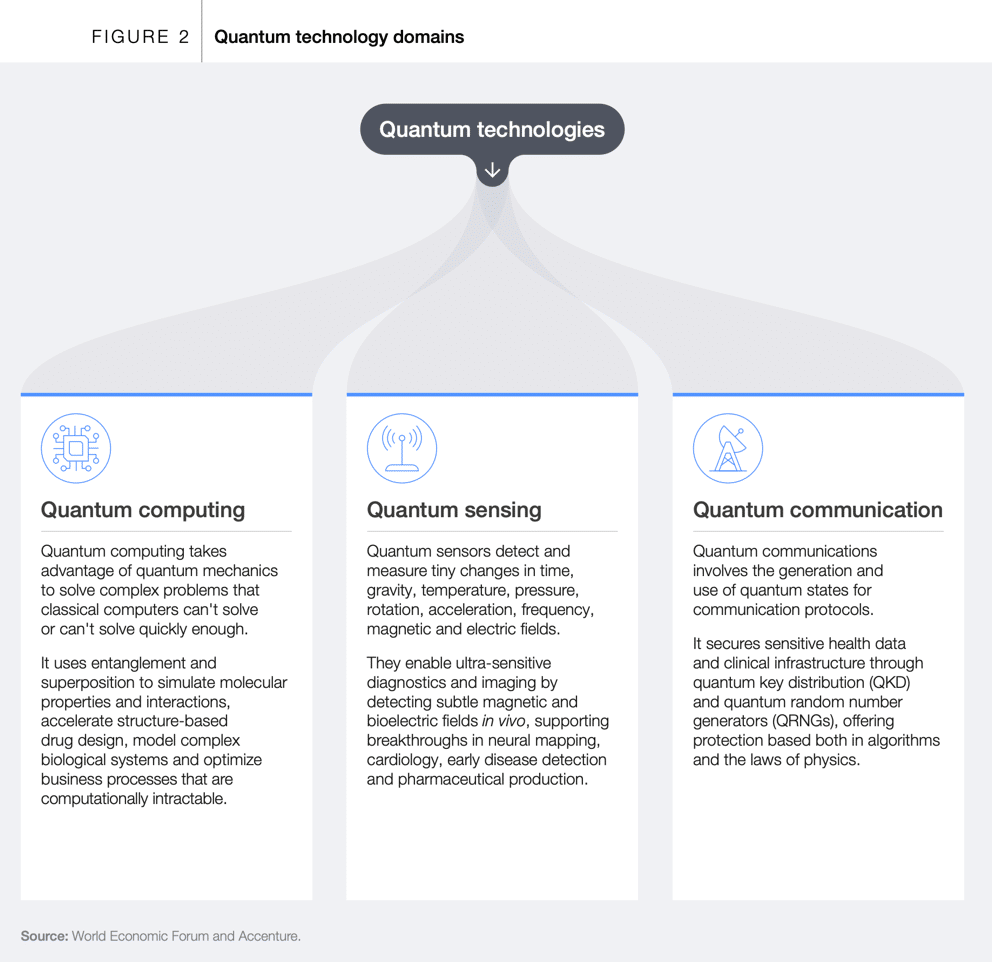
In particular, quantum sensors matter …
Quantum sensors enable significantly increased precision in measuring physical properties, especially in environments where conventional sensors reach their limits. This includes quality control, predictive maintenance, and process monitoring. As a result, they are expected to significantly accelerate research.
Quantum sensors have substantial commercial potential because they primarily replace or upgrade existing sensors (GPS, magnetometers, gravimeters, atomic clocks, etc.). Even small improvements in precision can be extremely valuable in sectors such as energy, defence, and geology. Notably, quantum sensors remain largely invisible in the public EU debate. As a result, regulatory and political resistance is low. This is one reason why European companies have focused on this area and achieved leading positions in niche markets. Among technology companies, these include KWAN-TEK (FR), Aquark Technologies (UK), AUREA (FR), Cerca Magnetics (UK), Qnami AG (CH), QSensato (IT), and QuantumDiamonds (DE). In addition, the EU’s European Quantum Flagship initiative coordinates R&D across universities and industrial partners.
In the pharmaceutical industry, improved quantum sensors are expected to significantly shorten development timelines. This opens the door to real-time coordination of sensory feedback for applications such as robotic surgery and nanobots, enabling entirely new treatment modalities.
Finally, long-term advances in quantum sensors are necessary for AI to develop the two critical senses of proprioception and interoception. These are particularly important for the development of AGI and, ultimately, sentience.
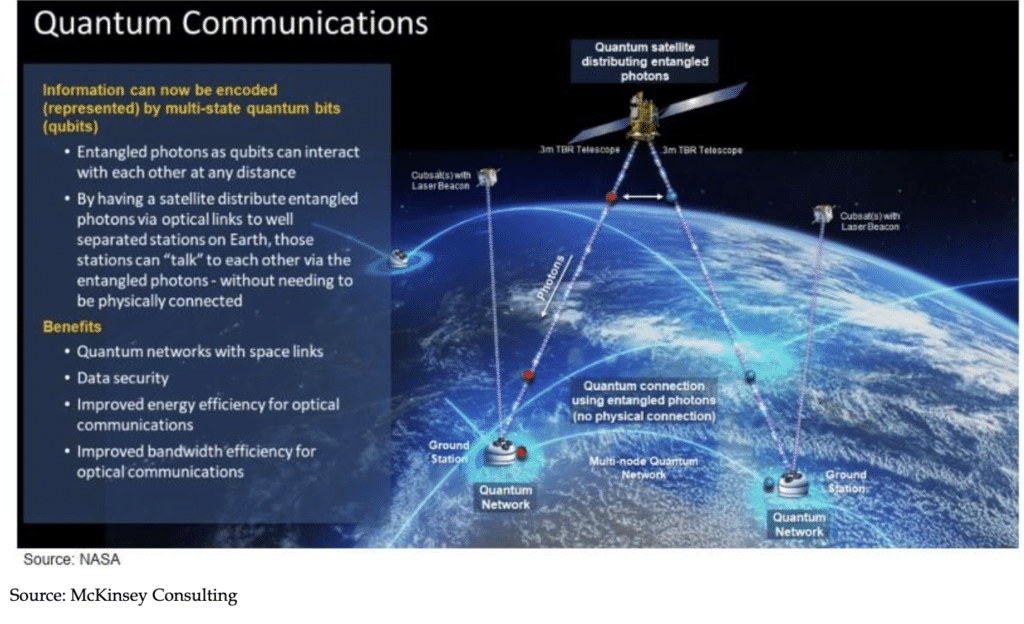
… and quantum communication
Quantum communication offers both greater security and greater capacity.
- Security arises because, according to quantum mechanics, a quantum state cannot be measured without being altered (the no-cloning theorem). If a third party attempts to intercept a quantum connection, the system will immediately detect the intrusion, and communication can be halted.
- Capacity stems from the simultaneous aspect of quantum information. Quantum information is transmitted via photons travelling at the speed of light — as in fibre-optic connections today. Since the speed of light is the physical upper limit, quantum communication does not directly increase transmission speed. However, it can dramatically enhance coordination between systems in quantum networks or distributed computing environments. Entanglement, for example, enables synchronisation and correlation across very large distances. Quantum computers can therefore perform computations distributed across multiple machines, significantly increasing the network’s aggregate computational power.
As a result, quantum communication ranks very high on the priority lists of militaries and governments worldwide, as well as the financial sector and research-intensive companies. The geopolitical picture is as follows:
- China is the global leader. The Micius satellite (QUESS) and Jinan-1 have for several years been used to refine quantum communication over distances of thousands of kilometres. During 2026, China is expected to launch an additional 1–5 quantum communication satellites. China has also shared elements of this technology with Russia.
- The EU’s EAGLE-1 satellite is expected to launch around the transition between 2026 and 2027.
- Around the same time, Boeing (Q4S) and DARPA are expected to launch their quantum-secure satellites.
Quantum communication also has military applications
Western intelligence services assess that a key motivation behind China’s early focus on quantum communication is that principles derived from ghost imaging may make it possible to detect stealth aircraft such as the F-35. China is believed to be close to a practical breakthrough in this area.
In the longer term, quantum communication, together with quantum computers and quantum sensors, is expected to form the foundation of a quantum internet, where data transmission and computation occur at the quantum level with extremely high security.
- This technology is already being developed in smaller, closed systems, including at the Niels Bohr Institute (NBI) in Copenhagen. NBI is among the world’s leading research institutions in quantum technology, made possible in part by substantial support from the Novo Nordisk Foundation.
The financial sector has long recognised the disruptive potential …
For many years, the financial sector has been aware of the commercial opportunities offered by QT in risk management, investment, and hedging.
QT is expected to confer decisive first-mover advantages, delivering both margin and scale benefits (“lower risk, higher return”) that extend far beyond high-frequency trading:
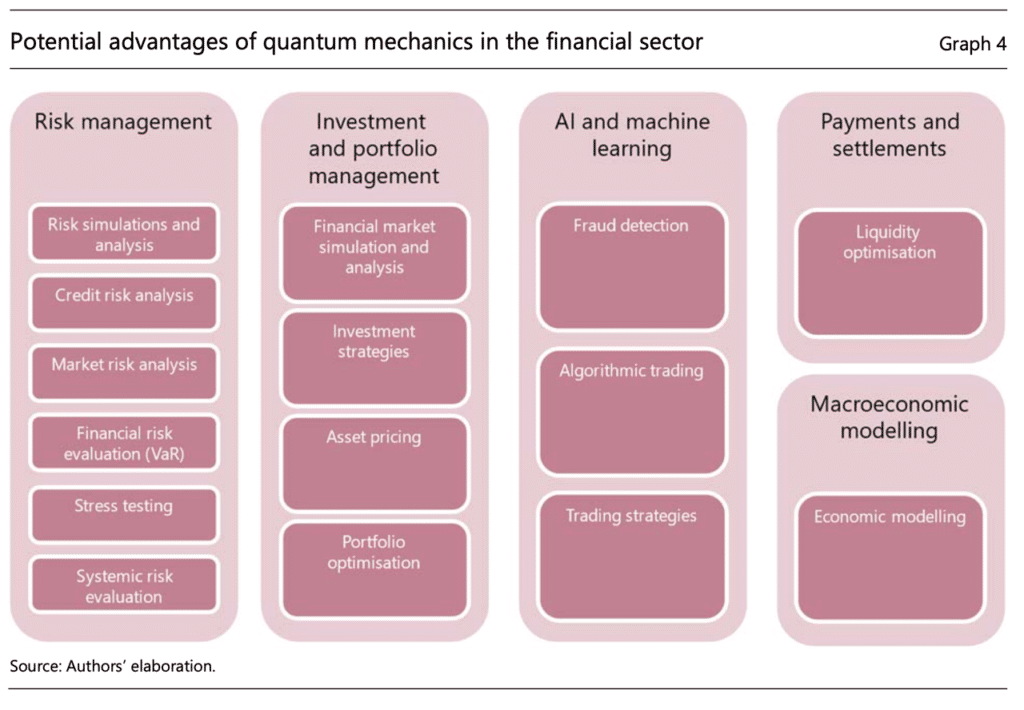
… because the sector is built on trust and data sensitivity
The sector is characterised by extreme data intensity and tightly coupled systems for clearing, settlement, and collateral management. As a result, central banks have long devoted exceptional attention to this emerging technology.
- In particular, quantum cryptography has been a focal point, as the financial system rests on a foundation of trust. Without trust and confidence, an economy cannot function. Concretely, quantum cryptography represents a potential Achilles’ heel for monetary infrastructure — especially for the validation and legitimacy of CBDCs. CBDCs are currently central to the ECB’s rapidly accelerating objective of achieving strategic autonomy vis-à-vis US digital stablecoins issued by private Big Tech firms. These stablecoins are seen as a precursor to attempts at deregulation and, ultimately, erosion of the euro’s role for EU citizens.
- In addition, QT provides central banks and supervisors with entirely new tools for macro-modelling, including inflation expectations and crisis management (e.g., oversight of systemic risks).
Time asymmetry is particularly concerning …
The BIS is especially concerned about time asymmetry: when the past becomes vulnerable, the present becomes uncertain, and the future becomes strategic. Preparation for Q-Day must happen yesterday, because data harvested today, even if encrypted, may be compromised tomorrow. States with large accumulated datasets and the capacity to decrypt them gain substantial retrospective power, potentially shifting power balances abruptly. This may also challenge the democratic foundations of the global financial system. Accordingly, the BIS plays a central role in:
- developing roadmaps for post-quantum migration, such as PQC protocol testing between Banque de France and the Bundesbank in 2025, and
- testing quantum optimisation in practice within banks and financial market infrastructures using first-generation PQC algorithms, including current PQC signature tests with Nexi, SWIFT, and national central banks.
… especially during the transition period
It is crucial to remember that the hybrid period, during which classical and PQC infrastructures coexist, is the most dangerous phase. This is when arbitrage opportunities, attack surfaces, and compliance confusion emerge. Clear leadership from the ECB could be particularly valuable during this phase.
Overall, quantum technology is a sovereign and critical capability
Taken together, quantum computing challenges the financial sector by altering the fundamental assumptions of trust, symmetry, and predictability in the monetary system. The primary risk lies in asymmetry, who understands, who has access, and who arrives too late? Private actors versus supervisors?
At a systemic level, the principal risk scenario follows Minsky logic: a breakdown of mutual confidence that belief in the future can continue to finance the present. This scenario may be amplified if QT develops faster than our ability to comprehend and adapt to it.
Quantum technology is therefore a sovereign capability, not a free market. There is a risk of “winner takes almost everything.” As such, it is something states must never fully delegate to the market. It is a matter of national security and geo-economic power. States can limit diffusion if there is broad global transparency regarding how far the technology has actually progressed. Export controls and alliance coordination can only mitigate parts of the risk.