
The international order is gradually shifting away from an integration-oriented approach towards the major powers and towards a more uncertain multipolarity. In this environment, major powers compete in an increasingly complex geopolitical reality without a shared global architecture. This increases the importance of Middle Powers as regional “system engineers” capable of creating stability and coordination between larger centres of power. ASEAN is a clear example of this. But how far can ASEAN’s influence extend?
ASEAN is held together primarily by shared interests rather than shared values; economic development without surrendering strategic autonomy or national sovereignty. The more important strategic autonomy becomes, the greater the risk that it may challenge ASEAN’s cohesion.
Its members already differ significantly in political systems, economic structures, security priorities and relationships with major powers. ASEAN therefore faces challenges if the interests of its member states continue to diverge. Where do members believe they can most effectively and broadly advance their interests: through ASEAN or through a major power such as China? In a multipolar world, the question becomes increasingly relevant: How far can states cooperate on growth and security without surrendering too much strategic autonomy? What should states in Latin America, Africa, Central Asia or MENA consider?
ASEAN’s dynamics are examined in three blog articles structured as follows:
- What holds ASEAN together?
- What Limits ASEAN's Cohesion?
- How far can ASEAN’s influence extend? (this blog post)
Overall, ASEAN Is Already a Strong Economic Region …
ASEAN is the most important regional power factor in one of the world’s fastest-growing economic regions, Southeast Asia. At the same time, its member states occupy some of the most important geopolitical crossroads of global trade. As a result, ASEAN’s potential influence increases, all else being equal, as the world becomes more fragmented.
- ASEAN is among the world’s largest markets, with more than 700 million inhabitants and a combined GDP approximately 25% larger than that of Mercosur. Although the nominal GDP of ASEAN’s 11 members is only around one-fifth that of the European Union’s 27 members, ASEAN’s growth rates, natural resources, stages of development and demographic trends make it one of the most attractive markets in the world.
- Furthermore, some of the world’s most important production centres for electronics, manufacturing, commodities, energy and global supply chains are located within ASEAN member states.
- This development continues today, driven in part by the re-shoring and diversification of manufacturing from China by American companies, often described through strategies such as “China Plus One” or “Anywhere But China”.
… and Its Influence Will Increase Further Because of ASEAN’s Strategic Location
ASEAN therefore represents an increasingly important part of the infrastructure of the global economy.
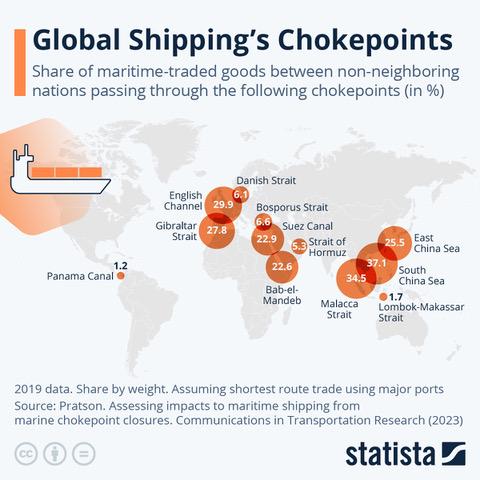
Geography reinforces this position. Some of the world’s most important trade routes pass through waters bordering or overlapping ASEAN members’ territorial seas. This includes the Strait of Malacca and the South China Sea, which connects the Pacific Ocean with the Indian Ocean. The region effectively links China, India, Japan and Australia. All of these economies depend heavily on exports and imports.
This gives ASEAN member states significant soft power through their role as guarantors of freedom of navigation and providers of critical transshipment hubs. Southeast Asia is therefore a region to which all major powers seek access:
- The United States seeks a security presence
- China seeks market access and supply chains
- Japan seeks investment and production opportunities
- India seeks economic integration towards the East
- The European Union seeks market access and industrial partnerships
But ASEAN Is Unlikely to Become a Unified Geopolitical Actor …
The interests of ASEAN’s members differ significantly across a number of critical issues. ASEAN is therefore likely to remain a platform for coordination rather than evolve into a genuine geopolitical union.
ASEAN derives influence through cooperation among sovereign states. This differs fundamentally from the European Union, where member states have gradually transferred decision-making powers to common institutions that can, at times, act contrary to individual national interests.
For many states outside the West, ASEAN’s model is therefore more attractive than the EU’s integration model. Many countries in Africa, MENA, Central Asia and Latin America seek greater regional coordination without surrendering national sovereignty. They want access to larger markets, improved investment conditions, stronger negotiating positions and greater regional stability. However, they often lack the necessary trust in, and alignment of interests with, neighbouring countries required for common currencies, common legislation or supranational institutions.
… Because Deeper Agreement Is Determined Case by Case
ASEAN’s strength lies in its ability to keep very different member states aligned around shared interests. This makes the organisation significantly easier to expand and makes the model considerably easier to replicate elsewhere in the world. Conversely, limited integration makes ASEAN vulnerable if major powers can offer individual member states greater benefits than ASEAN itself. A major regional security crisis, for example involving Taiwan, would be a significant test of ASEAN’s ability to preserve internal cohesion and thereby maintain external relevance.
ASEAN’s influence grows when its members act collectively. Yet its institutions are deliberately designed to preserve the national freedom of action that member states seek to protect.
ASEAN’s Resilience Will Be Tested Most Directly by US–China Rivalry
ASEAN’s future therefore depends heavily on the rivalry between the United States and China. If that rivalry remains manageable, ASEAN can continue to function as a balancing intermediary between the two powers.
If the world instead moves towards more explicit bloc formation, whether through a Chinese invasion of Taiwan, greater confrontation in the South China Sea, or broader technological conflicts, the organisation will come under increasing pressure. The more member states are forced to choose sides, the more difficult it becomes to preserve the strategic balance on which ASEAN is built.
ASEAN’s Greatest Strength Is Its Ability to Bring Others Together …
ASEAN’s greatest strength lies in its ability to position itself at the centre of regional cooperation, more than in its own economic or military weight.
While major powers compete directly with one another, ASEAN has increasingly positioned itself as the neutral platform through which dialogue takes place.
Its influence is rooted largely in the principle often described as “ASEAN Centrality”. ASEAN’s purpose is to ensure that no regional order can function effectively without ASEAN’s participation. ASEAN is therefore more about relevance than raw power.
… and This Is Why It Represents an Attractive Model for Cooperation Elsewhere
In a multipolar world, the ability to create cooperation between different centres of power becomes increasingly valuable. ASEAN has developed experience in this area that few, if any, regional organisations can match. It therefore has the potential to become the most influential model for regional cooperation among sovereign states. The key measure of success will be how indispensable ASEAN can make itself between competing centres of power, diplomatically, commercially and as a destination for investment.
ASEAN is strongest when its members cooperate. Yet they participate in ASEAN precisely because it allows them to place national interests above ASEAN’s interests when circumstances require.
In a multipolar world, states must balance the strategic weight gained through cooperation against the sovereignty they are willing to surrender.
Can they trust that their partners will continue to place greater value on shared interests than on privileged arrangements with major powers?