

The development of quantum technology (QT) is accelerating rapidly. It will boost AI development and enable major R&D breakthroughs, particularly in medicine, biotechnology, and materials science. However, the technology also brings quantum cryptography much closer. This is especially risky because it changes who knows what, and when. In the words of the NSA, NATO, and the BIS: “Prepare now for a world in which classical public-key cryptography can no longer be trusted.” After the Post-Quantum Transition Point (PQC), historical data will in practice become decryptable.
What is the current status of development, how does it affect geopolitics, and how should boards address QT as an irreversible and time-asymmetric condition?
This blog post is the first in a series of three on quantum technology:
- The development of quantum technology is rapidly accelerating
- Quantum technology introduces new risks, including for the financial sector
- Geopolitical decoupling increases the risk posed by quantum technology
Quantum technology is the realisation of quantum mechanics
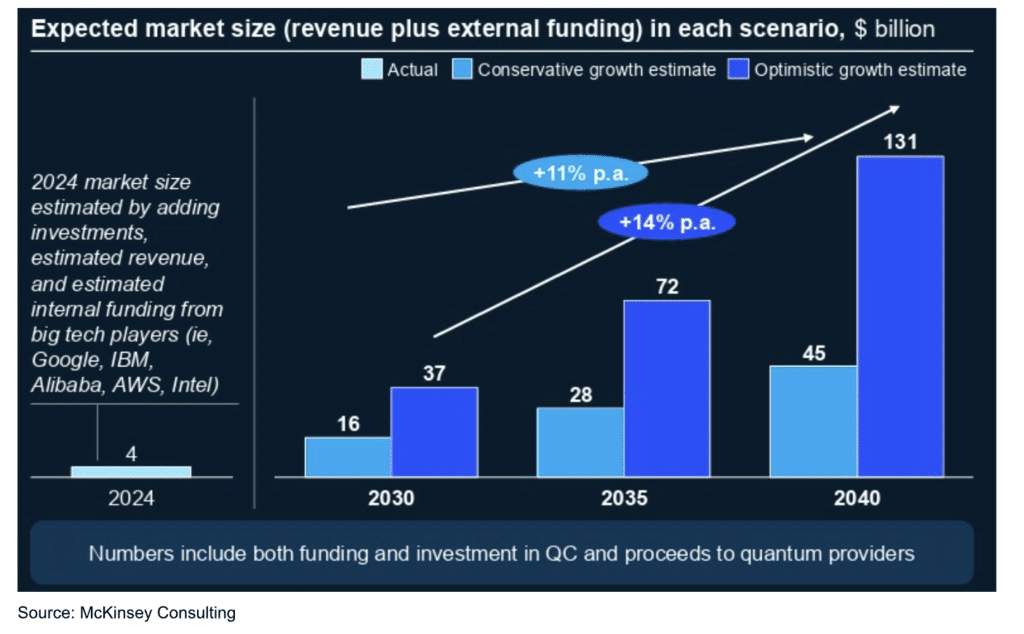
2025 marked the 100th anniversary of the first theoretical breakthroughs in quantum mechanics. The UN highlighted its significance by designating the year as the International Year of Quantum Science and Technology. The timing was well chosen, as progress in quantum technology over the past few years has far exceeded expectations. Both qubits and quantum sensors are now approaching TRL 7–9. As a result, global investment in QT is expected to rise to around USD 100 billion annually over the next ten years.
There is a growing technological and economic need
The growth model of modern economies fundamentally relies on increasing productivity. Since the 1980s, this has been enabled by rising computational power and automation. However, physical limits are approaching for how small transistors can become. When they shrink below roughly five atoms (nanometres), quantum effects (electrons behaving as waves) become unstable. “Moore’s Law” can be extended through new techniques, materials, and architectures such as High-NA EUV, CFETs, and optical chips. But fundamentally, the elephant in the room is quantum technology.
Two defining characteristics of quantum mechanics
Quantum technology is primarily based on the principles of superposition and entanglement:
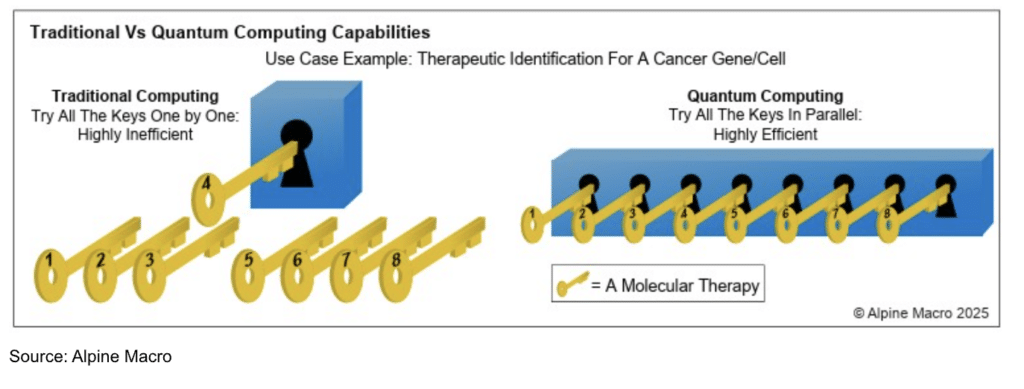
- Superposition means that electrons can exist in multiple states simultaneously. This allows quantum computers to explore many possibilities in parallel, whereas classical computers are limited to a single sequential path at a time. This enables exponential increases in computational power for certain problem types, particularly those, requiring simulation.
- Entanglement means that quantum particles can be linked in such a way that a change in one particle instantly affects another, regardless of distance. In a quantum computer, qubits therefore operate as a single integrated system rather than isolated sequences. This makes it possible to optimise many variables simultaneously. The interaction between the number of qubits, error rates, and algorithmic structure can multiply effective computational power.
QT will open entirely new research opportunities …
Quantum computers are currently expected to enable breakthroughs in areas such as:
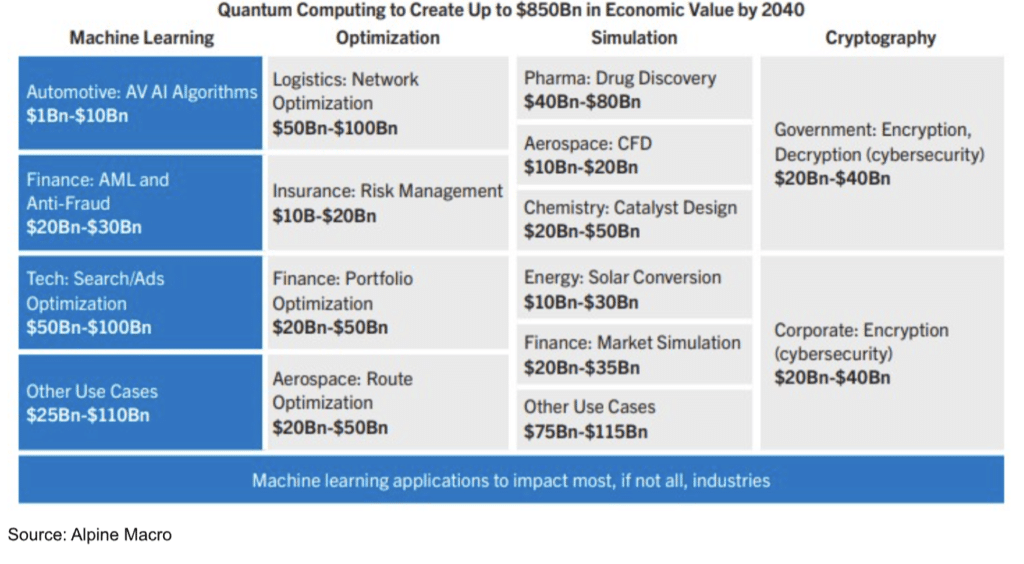
- Food production, where modelling nitrogen fixation and CO₂ binding could lead to new types of climate-friendly fertilisers, reducing geopolitical dependencies on Russia and Morocco.
- Energy, where quantum calculations are required for advanced meteorological forecasting and, more concretely, for stable plasma control in fusion energy. Google DeepMind is particularly active here.
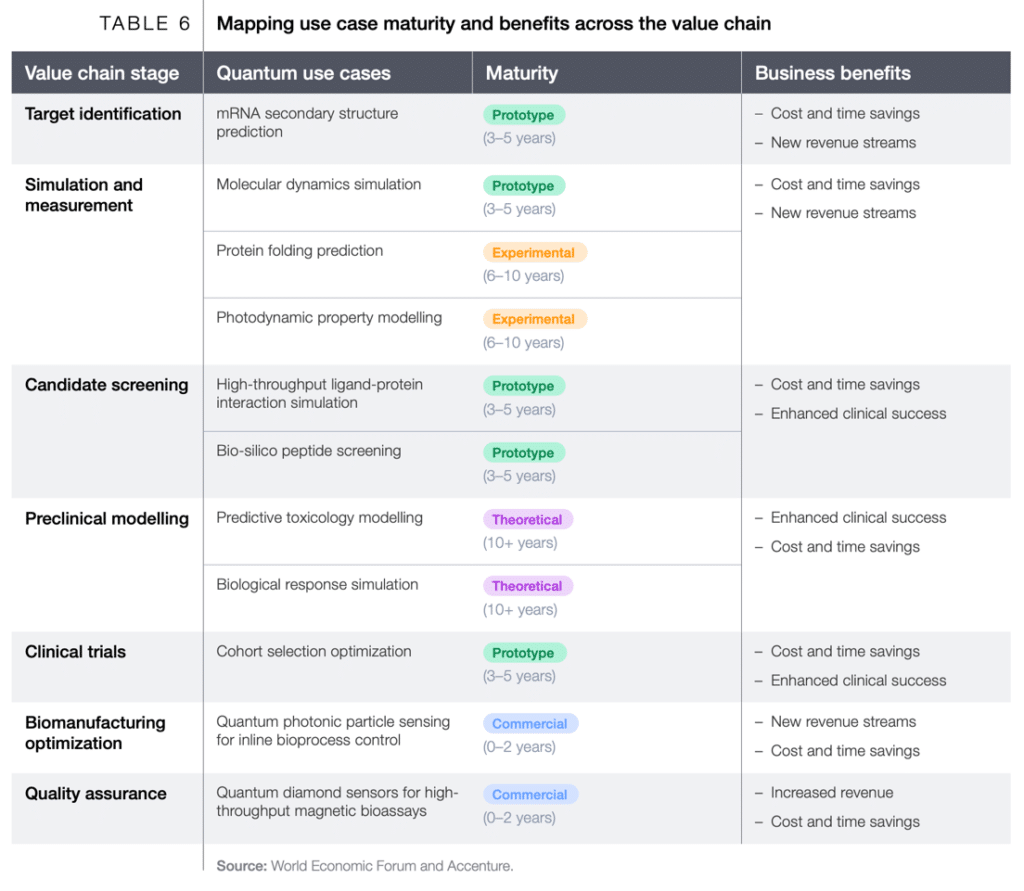
- Medicine and biotechnology, where R&D can shift from trial-and-error to molecular in-silico simulation. This is expected to significantly reduce side effects, especially in oncology, and shorten development timelines for vaccines and pharmaceuticals. IBM’s collaboration with the Cleveland Clinic is one example. According to the World Economic Forum, the pharmaceutical and biotech sectors are likely to see some of the largest research breakthroughs.
... modelling, ...
- Materials science, where "inverse design" and context-based design suddenly become realistic. Over time, this strengthens strategic autonomy by enabling local material production rather than dependence on foreign mining and refining.
- Finance, where macroeconomic and financial-market modelling is currently extremely complex.
- Commercial results are promising: HSBC’s tests on IBM quantum systems showed a 34% improvement in bond-trading predictions, as well as benefits for portfolio optimisation, risk modelling, and option pricing.
... because QT is more than "just" greater computing power
The combination of superposition and entanglement means that quantum computers are more than merely faster computers. They enable entirely new applications (“quantum advantage”) that may exceed today’s imagination. QT therefore has systemic consequences for the economy, democracy, and geopolitics.
- Quantum technology fundamentally affects encryption. Quantum information cannot be read or copied without being altered (Heisenberg uncertainty principle). This enables theoretically perfect encryption, but only through new hardware (QKD, Quantum Key Distribution) and software (PQC, Post-Quantum Cryptography). Conversely, the superior computational power means that encrypted information from before Q-day can be decrypted.
QT therefore has geopolitical impact
As a result, an unusually broad range of actors are investing in quantum technology: commercial firms, national research institutions, and defence industries.
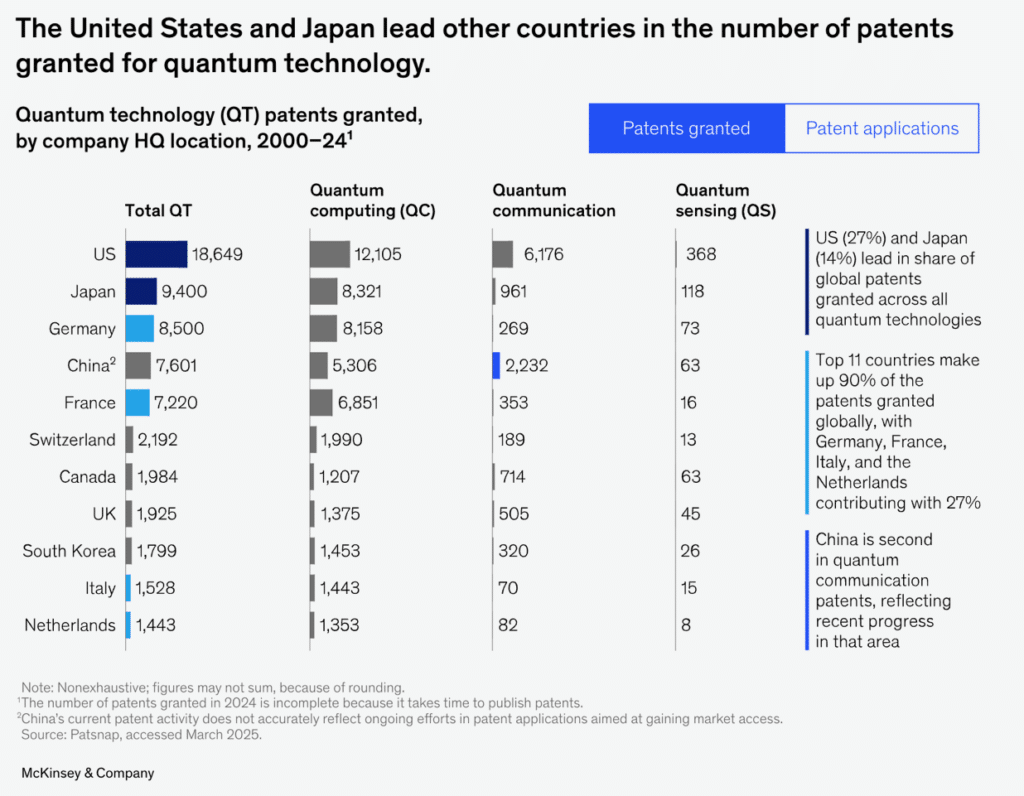
The United States and Japan currently have strong focus and development levels, but the underlying picture is more complex. No country can develop quantum computers alone. Nevertheless, this has been a US objective since 20 January 2025. Based on patent data China currently holds the broadest knowledge base across critical QT technologies, giving it a strong position for global quantum dominance. US geopolitical decoupling from the rest of the world, including the EU and India, strengthens China’s lead, but may also create opportunities for Europe to close the gap.
QT is moving closer to commercial launch …
Some quantum computers have now reached technological maturity levels suitable for laboratory test environments (TRL 6–7). In 2024, Google and Amazon presented their Willow and Ocelot quantum chips, showing significant improvements in stability. Microsoft’s Majorana approach is less certain, but has similar long-term potential.
Error correction has so far been the main obstacle to scalability. Physical qubits, such as superconducting circuits, ions, photons, or topological states, are fast but inherently unstable with respect to minimal fluctuations in:
- temperature, because superposition reguires that the thermal energy is less than the energy difference between qubit states. In reality this equals between 10 and 20 millikelvin
- electromagnetic noise , from e.g. cellular phones nearby
- vibrations from e.g. heavy traffic
- cosmic radiation causing bit flips
Reducing these sensitivities, particularly cooling requirements, is a major development focus. Cooling requires a lot of energy.
… because error-correction capabilities are improving
The key performance metric is the number of logical qubits a system can handle—reflecting how effectively software corrects errors. In 2025, companies such as Alice & Bob, Riverlane, and Atom Computing demonstrated major advances in quantum error-correction architectures. While error correction is still handled by classical supercomputers, QT is expected to take over within 3–4 years.
Companies like QuEra and Quantinuum have already operated 12–48 logical qubits in controlled environments. Commercial viability is generally expected to begin around 100 logical qubits.
Hardware development is becoming increasingly hybrid and adaptive, with CPUs, GPUs, TPUs, QPUs, and neuromorphic hardware converging.
Timing remains uncertain, but key patterns are emerging
Commercial QT is approaching, though precise timing remains uncertain. The period until 2029 is often described as “the dawn of quantum utility.” Expectations can be divided into three phases:
- Enabling infrastructure (now–2027): materials, semiconductors, cryogenics, hybrid cloud architectures
- Applied disruption (2027–2035): cybersecurity overhaul, pharmaceutical simulation, logistics optimisation
- Widespread Integration (post-2035): quantum embedded in finance, national security, and AI systems
IBM expects to pass the critical threshold of 100–200 logical qubits before 2029. Beyond that point, scaling to millions of logical qubits may take years rather than decades. Some players, such as IonQ, even expect to cross this threshold imminently.
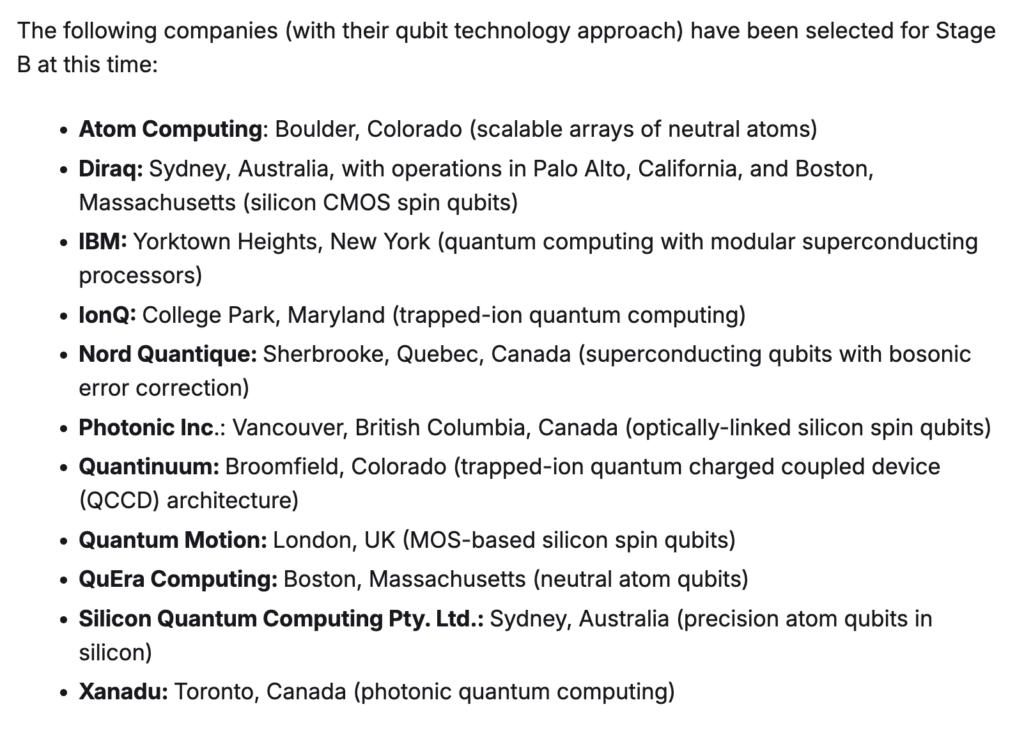
The US DARPA (Defense Advanced Research Projects Agency) is focusing in particular on the following companies:
To be continued in the next blog post