
Financial bubbles normally burst when confidence in the reasonableness of valuations tips among a sufficient number of market participants. This point is typically reached when liquidity becomes scarce or when confidence breaks down that the economic returns on investments will match their financing. It is impossible to predict precisely when or why a bubble will burst, because collective confidence, or lack of confidence, cannot be measured unambiguously. There are, however, indicators of underlying confidence, in the form of liquidity conditions and risk appetite, that are likely to weaken before the bubble itself bursts. This is the third and final blog post on identifying financial bubbles, this time focusing on short-term financial indicators.
A bubble burst is unlikely to be imminent …
Bubbles normally burst when doubt has been building for a long time. The doubt is ultimately triggered by relatively small events, often originating outside the market itself.
In the longer term, there is currently strong and stable confidence within the financial system, including between banks, as discussed in the previous blog post. There is, however, growing doubt about whether AI will transform the economy as quickly as current financing assumptions imply.
… but the “duration mismatch” mechanism appears increasingly plausible
The doubt is probably not critical yet, but it concerns a classic “duration mismatch”. This was, for example, the mechanism behind the dot-com bubble. At the time of investment, we choose a financing structure whose payments and maturities reflect when we expect the economic returns to be realised. When the timing of those returns is pushed back, they no longer match the payment profile of the financing.
Over the coming period, it is therefore worth monitoring a number of relatively short-term indicators of how deeply and broadly doubts about AI's transformative effect on the economy are taking hold among AI investors. The greater the underlying doubt, the smaller the event required to burst a bubble.
A bubble could be triggered by a shortage of liquidity and financing …
Among the short-term indicators, the following are currently particularly relevant:
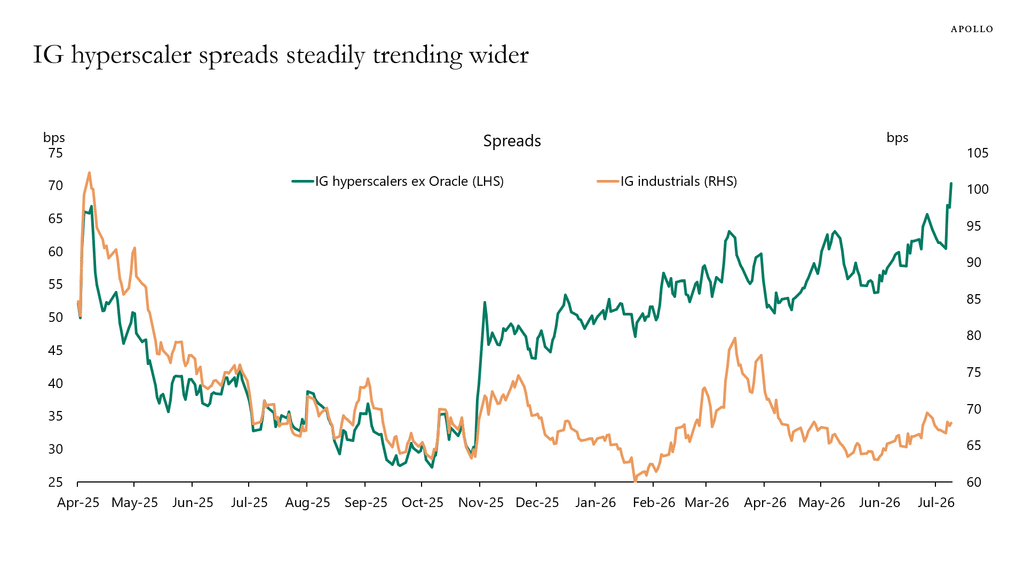
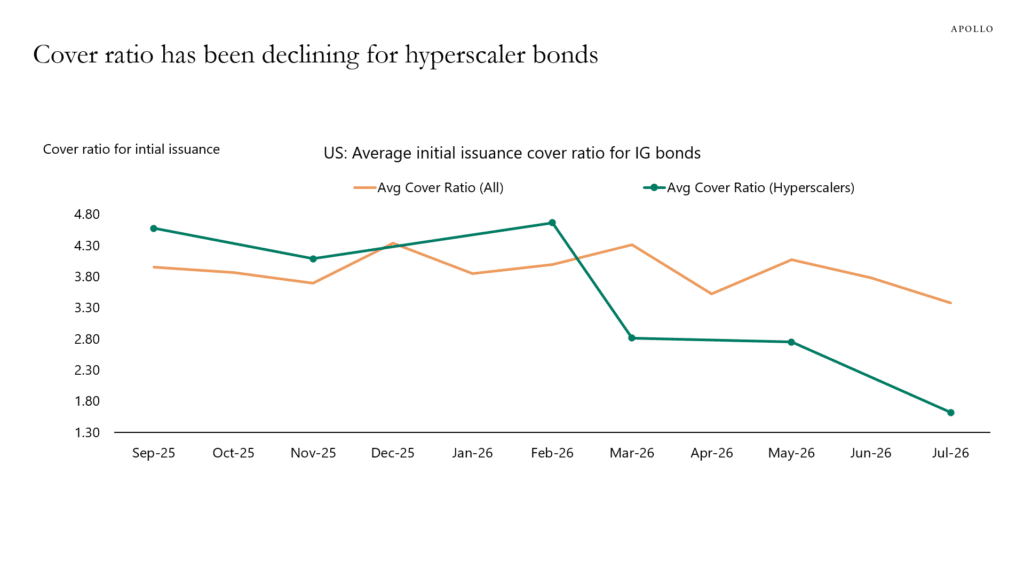
- Liquidity adequacy. AI is extremely investment-intensive, particularly in irreversible assets such as data centres. AI development therefore depends on continued strong investor demand. In the short term, it is particularly worth monitoring whether there continue to be substantially more buyers than sellers of bonds issued by hyperscalers. Since February/March, these cover ratios have fallen markedly relative to the rest of the market. According to Apollo, cover ratios were close to 5 in February but had fallen to just 1.8 in July, as shown below. In August, they may have fallen to around 1.5–1.6. This remains comfortably above the level associated with “failed auctions”, but it could be an early sign that confidence in the timing of AI returns is deteriorating rapidly.
- Solvency risk among hyperscalers. If AI's transformative effect on the economy can only be realised later, this could quickly affect the solvency risk of many hyperscalers. They have invested heavily in data centres, which may therefore only generate an economic return somewhat later. Both hyperscalers and AI developers would then face refinancing requirements. This could quickly become difficult and expensive because the amounts invested are so large.
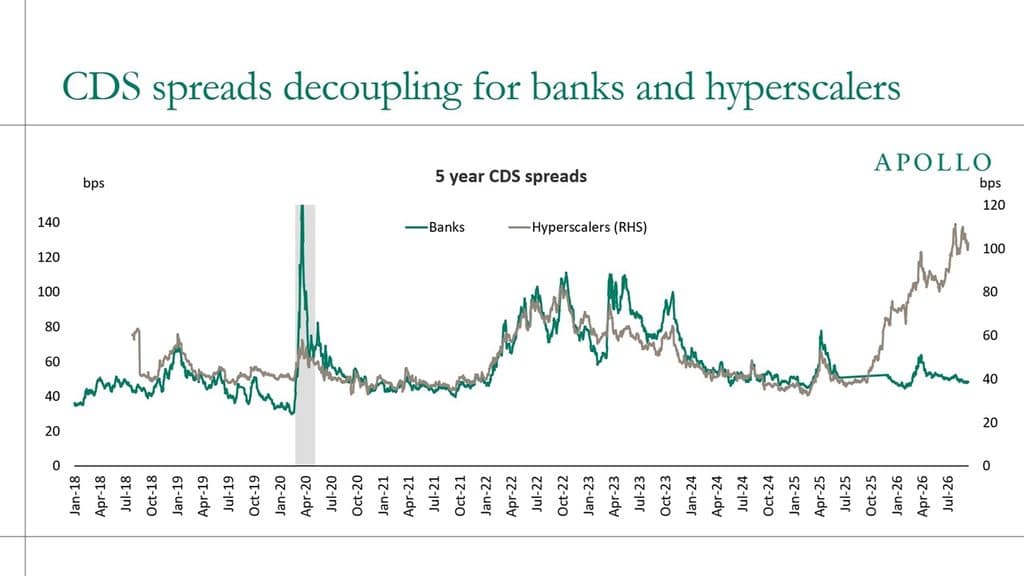
- Here, it is worth monitoring CDS spreads, the “cost of protection against default”, for hyperscalers, which are currently trending upwards, as shown below. They have probably not yet reached critical levels..
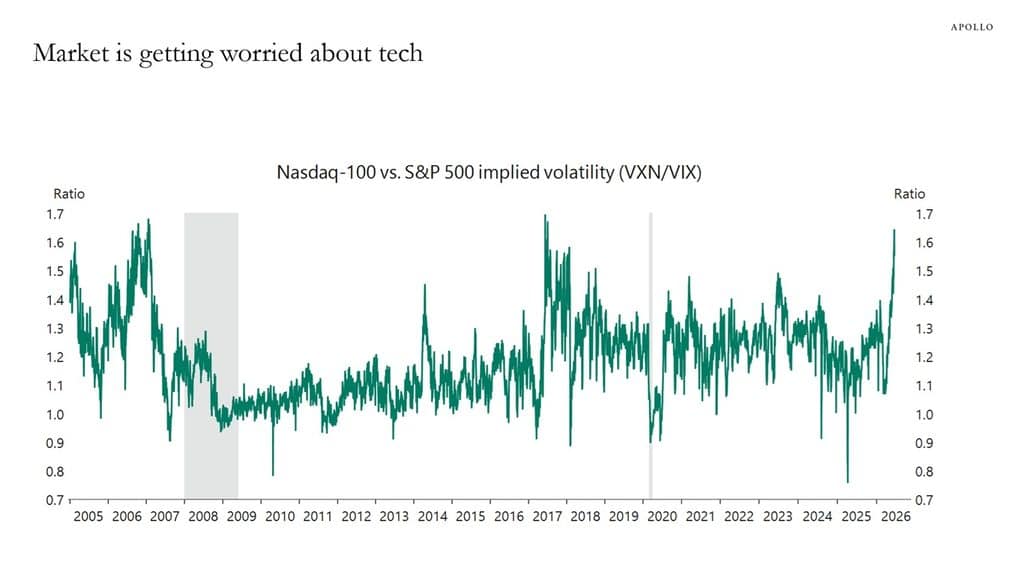
- Increasing volatility in technology stocks more generally may also indicate whether the market is becoming less certain about the reliability of returns from technology companies. Since February/March this year, volatility in technology stocks (the VIX for the Nasdaq-100) has been higher than volatility in the S&P 500, as shown below. Although the levels are probably not yet critical, the VIX indicates that uncertainty about AI returns is beginning to spread from the debt market to the equity market.
… but it could equally arise from doubts about which players will survive the shake-out
- Doubt about which players will capture the greatest economic benefits from AI. According to Stanford University's HAI, the gap between the leading US and Chinese models is now very small. This has happened despite China having less than one-tenth of the US's data-centre capacity. In addition, prices for using Zhipu, Moonshot and DeepSeek are often up to nine times lower than those of the major US models. These price differences demonstrate that model capabilities are already subject to intense competitive pressure. Over time, this could put pressure on the ability of the AI ecosystem to generate profits and create uncertainty about which AI players will ultimately win the shake-out. As indicators, it is therefore worth monitoring the development in price per token and enterprise adoption for the three major Chinese developers mentioned above. Can the US AI players sustain the earnings required to justify their very large investments?
Overall, there are signs of emerging doubt, but it is probably not yet critical
Taken together, the three blog posts in this series suggest that the long-term, broad market indicators continue to point to strong mutual confidence within the financial system. There are therefore no signs that a bubble burst is likely to be triggered by systemic liquidity shortages.
The long-term AI-specific indicators, however, suggest growing doubt about when AI investments will translate into economic returns. This has, among other things, increased uncertainty about the credit quality of AI companies and means that an increasing share of AI financing is now coming from increasingly risk-tolerant sources. The indicators are nevertheless probably not yet at critical levels.
This picture is supported by the short-term indicators, all of which are moving in the direction of greater stress, although none is probably at a critical level yet. There is growing doubt about which players will be able to turn AI's potential into economic returns, and when they will be able to do so. Investor demand in the bond market is therefore currently falling markedly. There are, however, still no signs that a collapse in confidence and a financial crisis are imminent.
It is prudent governance for a board to strengthen the company's resilience now
Part of the board's role is to ensure that the company can continue to operate when the world changes. The board should therefore ensure in particular that management continuously identifies and prepares the company for the most significant risks arising from AI and geopolitics.
- Is management, for example, working with alternative scenarios?
- Are critical dependencies on customers and suppliers known, and have redundant options been established?
- Are investments assessed against several possible future developments?
- Is the organisation strategically flexible and adaptable?.
- How strong are the company's culture, learning environment and mutual trust?
Strategy is fundamentally about resilience, options and adaptability.