
Financial bubbles normally burst when confidence in the reasonableness of valuations tips among a sufficient number of market participants. This point is typically reached when liquidity becomes scarce or when confidence breaks down that the economic returns on investments will continue to match their financing. It is impossible to predict precisely when a bubble will burst, because collective confidence, or lack of confidence, cannot be measured unambiguously. There are, however, a number of indicators of liquidity conditions and risk appetite in the market that are worth monitoring.
This is the first of three blog posts on financial bubbles.
There are significant signs that there is a financial bubble today …
The enormous AI investment boom is built around very specific expectations. But
- the direction of technological development remains dynamic and open, while
- the technology depends on continued growth in financing, and
- users adopting the technology much faster and more extensively than they do today …
… so there is heightened uncertainty over whether the economic gains from AI can materialise before the financing supporting the investments falls due.
… which risks bursting because financing is tightly linked to these expectations …
Today, these expectations are being challenged by several developments:
- Chinese AI models are now catching up with US models, according to Stanford HAI, despite having been developed using substantially less compute and far fewer data centres. Chinese models therefore appear to have more efficient learning architectures. This challenges the scaling hypothesis underlying the AI boom – the principle that the route to better algorithms runs through more data centres. Data centres account for the largest capital expenditure in the AI ecosystem.
- There are also signs that AI adoption is progressing too slowly. This matters particularly for when AI's substantial transformative potential can translate into measurable economic productivity.
- In a June 2026 survey of 5,000 companies in the euro area, the ECB concluded thatAI is being used widely by 70% of EU companies, but primarily to achieve relatively modest efficiency gains. 40% of companies believe they still lack the knowledge required to realise AI's potential, while 28% believe that their existing systems are not compatible with AI systems.
- Only 7% of companies use AI intensively enough to believe that they can realise a substantial part of its transformative productivity and innovation potential.
- Although overall adoption is therefore high, the degree of economic transformation remains low.
- The problem is that the relatively low level of intensive use has increased only marginally over the past year, for example when compared with a study by Anthropic from November 2025..
- The AI ecosystem has generally become so capital-intensive that continued investment requires continued access to financing. That becomes difficult if expectations of economic returns are pushed further into the future.
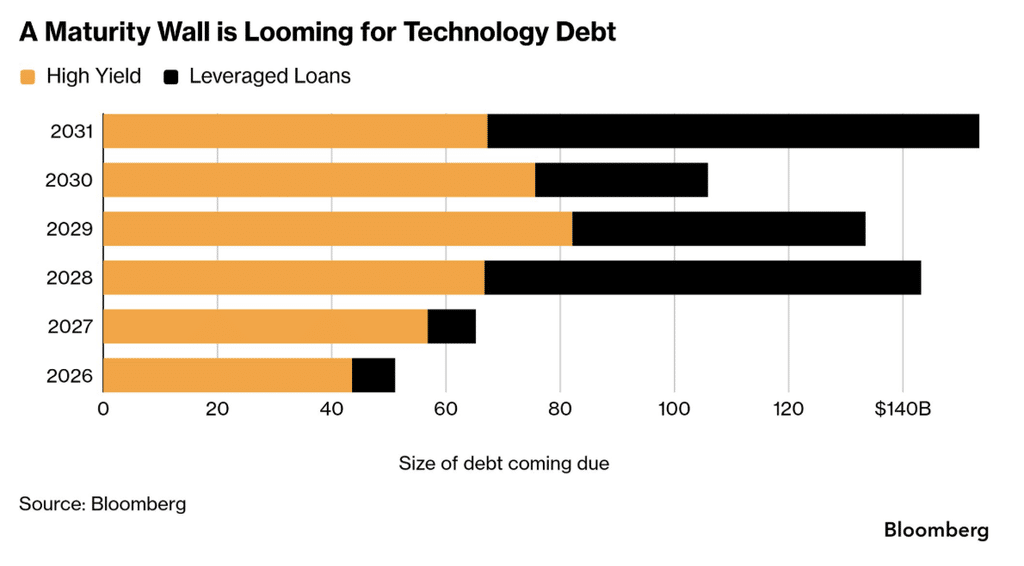
- The precise scale and timing of total debt maturities remain uncertain because some financing is provided by entities outside the reach of financial regulators. Earlier attempts to estimate debt maturities nevertheless indicate that maturities are likely to rise significantly from the beginning of 2028, as discussed below.
… with financing likely to fall due before earnings materialise
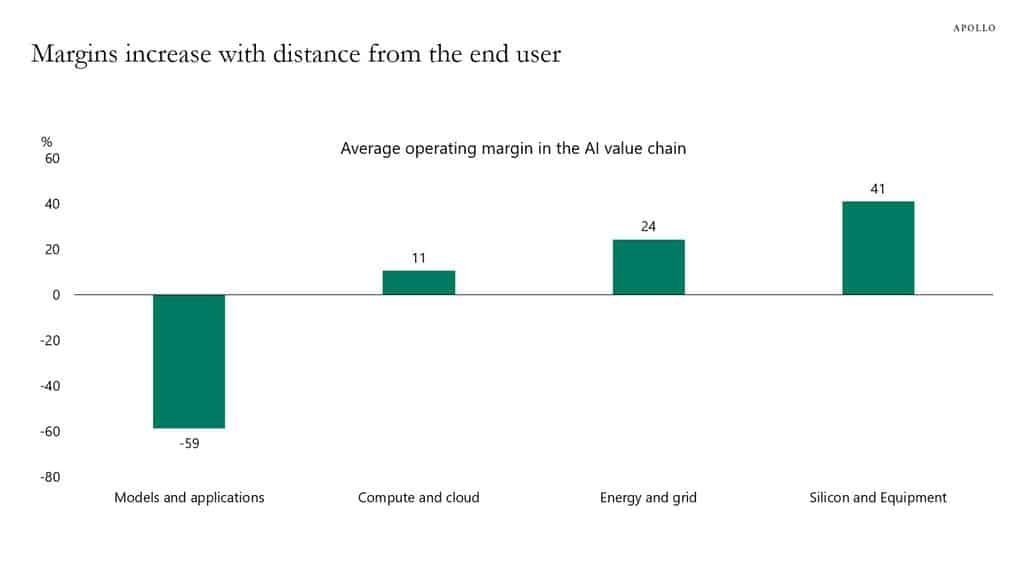
The systemic problem is compounded by the fact that earnings in the AI ecosystem are concentrated among the players furthest removed from the end user.
- This means that the earnings supporting the AI boom are funded by investors rather than generated by customers. Upstream margins may therefore be genuine, but they are ultimately paid for by capital raised by the layer of the ecosystem that is losing money.
A loss of confidence in AI investments could have deep, broad and systemic consequences …
The scale of investment is so large that it has become the largest component of US GDP growth. If investment were therefore to slow, the US economy could risk entering recession.
This would affect global economic growth and, in particular, global financial valuations. A bubble could therefore burst if a collective doubt emerged over whether AI's economic potential will materialise somewhat later than the financing currently supporting the investment assumes. Market psychology is critical to sustaining investment on such a large and concentrated scale.
… and could hit beyond the capacity of existing institutions to respond
The impact of a bubble bursting could be amplified by the fact that financing for the boom comes predominantly from sources outside the regulated and transparent parts of the financial sector (insert link to blog post featuring the Finans/Invest article). Central banks and financial stability authorities could therefore recognise the risk too late and face constraints on their ability to stabilise the financial system. Since the financial crisis, regulation of the financial sector has also specifically sought to prevent governments from having to rescue or take over failing financial institutions, through bail-in rather than bail-out mechanisms.
The impact of a loss of market confidence could therefore be deeper and broader than traditional macroeconomic scenarios involving, for example, interest-rate shocks or geopolitical shocks, because central banks may not be able to intervene as quickly.
For investors, preserving agility is prudent
All investments involve risk. This also applies to investments in cash or gold, which can, for example, lose value as a result of inflation or if central banks sell gold to obtain foreign currency needed to stabilise a market.
As an investor, it is therefore worth monitoring whether there are broad and increasing signs of declining confidence in AI's imminent transformative effect on the economy.
Under normal circumstances, remaining invested in the market is sensible because nobody can predict when a bubble will burst. Falling asset prices affect everyone who is invested. Losses will, however, vary depending on how exposed a portfolio is to broad-based losses of confidence and declines in revenues.
Liquidity resilience also tends to be critical during downturns
The greatest risk during a downturn typically comes from insolvencies triggered by pockets of illiquidity in the market. This often affects broader market confidence, because many companies hit by illiquidity may have been solvent but lacked sufficient resilience in their cash-flow reserves, for example because they were high-growth companies.
Managing a portfolio's exposure to an AI collapse therefore involves, in particular, rotating towards sectors and securities with low liquidity risk, high customer loyalty, stable revenues and strong brands, in other words, resilience in the underlying customer base. Debt markets may also offer attractive return potential because central banks often cut policy rates ahead of or during financial crises in an attempt to stimulate economic growth. Falling interest rates increase the market value of fixed-rate debt securities.
The next blog post will provide examples of indicators that are worth monitoring.