

This is part 2 of three on top leadership of AI disruptions
AI is more than merely a new technology. It is a universal catalyst that enhances human functions, cognitive, communicative and creative, for all individuals willing to use it. Compared with previous technological disruptions, AI has a far more intrusive potential, because it fundamentally alters the conditions for leadership, judgement, capabilities and competition. For this reason, AI adoption is also most effective when it happens bottom-up.
The task of top management is therefore primarily to encourage and motivate the use of AI, within carefully considered security frameworks.
It remains difficult to demonstrate where and to what extent AI has economic impact …
To date, AI development has primarily focused on Large Language Models (LLMs), i.e. reactive and task-oriented AI assistants. However, from this year onwards, all Big Tech companies have begun introducing proactive and goal-oriented AI agents. Here, human decision-making power and initiative are delegated to AI, initially within defined boundaries and with options for human configuration and oversight. This means that, going forward, humans can increasingly focus on the “what” and the “why”, i.e. objectives, meaning and ethics, while AI takes care of the “how”, i.e. execution and optimisation. The key to using the technology is therefore a collaboration between human judgement and machine efficiency.
AI technology is relatively new, and it therefore remains difficult to demonstrate clear economic gains from AI. Most organisations can nevertheless see the potential for comparative advantage and therefore primarily deploy LLMs.
… particularly within companies
At both company and societal level, however, there is as yet no measurable increase in productivity. According to Microsoft, most companies experience that AI tools for communication (email, etc.) with customers initially increase efficiency. However, this effect is often lost later on, as the overall volume of communication increases in parallel.
- A study by Boston Consulting Group shows,for example, that only around 5% of the 1,250 surveyed companies can demonstrate clearly measurable benefits (revenue, cost reductions or improved processes) from their AI investments. Companies still expect the gains to materialise, but acknowledge that the ramp-up period is “simply” longer than initially assumed.
- A global survey by Ernst & Young among large companieseven showed that most have experienced losses as a result of insufficient compliance, output errors, bias, and similar issues. However, those companies that had strong frameworks for Responsible AI achieved better outcomes.
- Research from Brookings nevertheless suggests thatthe use of AI in innovation environments does create growth. This does, however, require more technically qualified employees; something the US Army, for example, has recognised and adapted to accordingly.
For the gains often drown in increased documentation or demands for understanding
The uncertainty around the economic benefits is partly due to the fact that new documentation requirements often arise elsewhere as a consequence of the new technology. As a result, 95% of companies are still unable to demonstrate measurable ROI effects, according to MIT’s NANDA project. MIT refers to this gap between interest and implementation as “The GenAI Divide”. The predominant cause of inertia in AI adoption was that organisations often resisted internally, either out of fear of job losses or due to uncertainty. As Jensen Huang puts it: “AI is not going to take your job. Someone who uses AI will.”
There are, however, already some common characteristics among successful cases, …
MIT’s NANDA research indicates that companies that succeed do four things differently:
- They purchase technology rather than developing it in-house.
- They delegate decision-making authority to line managers rather than to staff functions.
- They select tools that integrate deeply and allow flexible adaptation
- Finally, the most forward-looking organisations are already experimenting with agentic flows, i.e. systems that learn, remember and act autonomously within defined boundaries.
Overall, MIT also shows that the adoption of AI tools varies significantly across industries:
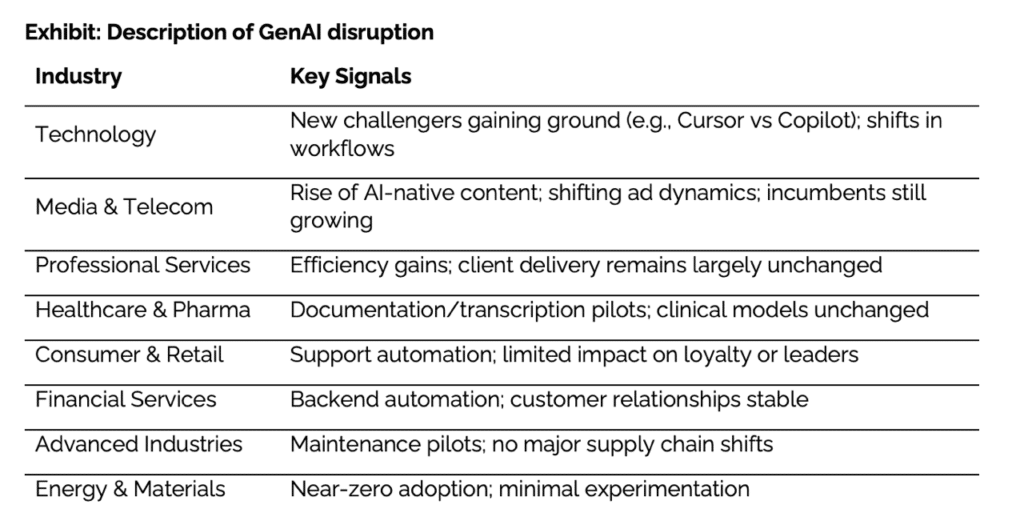
Industries and sectors that work primarily with the interpretation and dissemination of information have generally been quick to adopt AI tools (especially LLMs), while heavier and more traditional industries remain uncertain about both the opportunities and how to realise them. MIT points out that “first-mover” companies gain particularly strong conditions for becoming tomorrow’s winners. This is because the technology is developing at an exponentially rapid pace.
- An illustrative example is geothermal energy extraction, where AI has proven effective at predicting fractures and fissures in the Earth’s crust. This significantly reduces capital requirements.
… are primarily about the organisation’s mindset towards AI
Fundamentally, the better leadership and employees understand the company, its infrastructure, one another and themselves, the better positioned they are to turn the AI impulse into a positive transformation.
Curiosity about the possibilities of AI technology is therefore decisive. This applies regardless of whether the company is information- or technology-driven, or operates within traditional industries. Curiosity, in turn, requires trust and initiative among employees. Unlike traditional ERP systems, such as SAP, AI must be anchored bottom-up, while at the same time being driven by line functions. The technology is highly organic and self-developing. Continuous adaptation is therefore the key concept.
Top management must inspire and set frameworks rather than drive execution
With regard to AI, the primary role of top management is therefore to inspire adoption, demonstrate possibilities, and clarify the principles and mechanisms that drive the technology and thus shape the future. It is also essential to be involved in determining where human oversight of AI decisions must be established. AI is, among other things, only as good as the data on which it is trained. The risk of errors is significant in the early stages, much like with a new office trainee.
The lesson is therefore: “Stop trying to teach the machine how to think; let it learn”, as expressed by Professor of Reinforcement Learning Richard Sutton in “The Bitter Lesson”. The challenge is that leaders themselves must learn to lead in a reality where the machine learns faster than they can.
- Sutton’s 2019 essay is frequently cited in modern AI research. It concludes that the greatest advances in AI do not come from human insight or expert knowledge, but from algorithms that learn automatically through computational power and data.
- Every time we have attempted to encode our own knowledge directly, the solution has quickly become obsolete. Self-learning algorithms, by contrast, continue to improve as compute and data scale, as seen, for example, in computer chess, robotics and speech recognition.
- It is “bitter” because it undermines humanity’s self-image as the designer of intelligence. The implication is that AI development is primarily a question of capital, energy and chip infrastructure, rather than of knowledge and research.
- Sutton’s insights were subsequently confirmed by both OpenAI and DeepMind, which observed a clear relationship between model size, data volumes, computational power and performance (collectively referred to as the Scaling Laws for Neural Networks). These scaling laws underpin, among other things, the US AI strategy, including the Stargate Project.
To be continued in the next blog post.