
Today, AI surpasses human intelligence across a wide range of well-defined, isolated tasks, but not as a whole. To reach AGI, Artificial General Intelligence, two main elements are still missing: the ability to gather data that AI cannot access through data centres, and an increased ability to integrate all data. These are necessary to develop the key dimensions of causal understanding, robustness and intentionality. This is the first of three posts on the development of AGI and some of the risks it entails for the economy, governance, democracy and international cooperation.
The blog series is structured as follows:
- What is missing to reach AGI? (this post)
- Impact on the economy and governance (next post)
- The democratic and political risks of AGI (final post)
AGI emerges when all AI specialisations surpass human capability as a whole
Artificial General Intelligence, AGI, emerges when individual AI specialisations are coordinated into a coherent whole. At that point, AI moves from information to action. AGI is therefore more than “just” a specialised model; it is the foundation for general problem-solving.
There is still no broad consensus on how AGI should be measured or when it will be achieved. Only a few years ago, AGI was considered to be decades away. Today, however, several developments suggest it could emerge within the next five years if current trends continue. AGI is the explicit objective of organisations such as DeepMind and OpenAI, while Anthropic is in practice working with AGI-like systems and ambitions.
The gap has narrowed
According to the April 2026 status report from Stanford University’s Human-Centred Artificial Intelligence (HAI) , human intelligence is now surpassed across almost all individual domains:
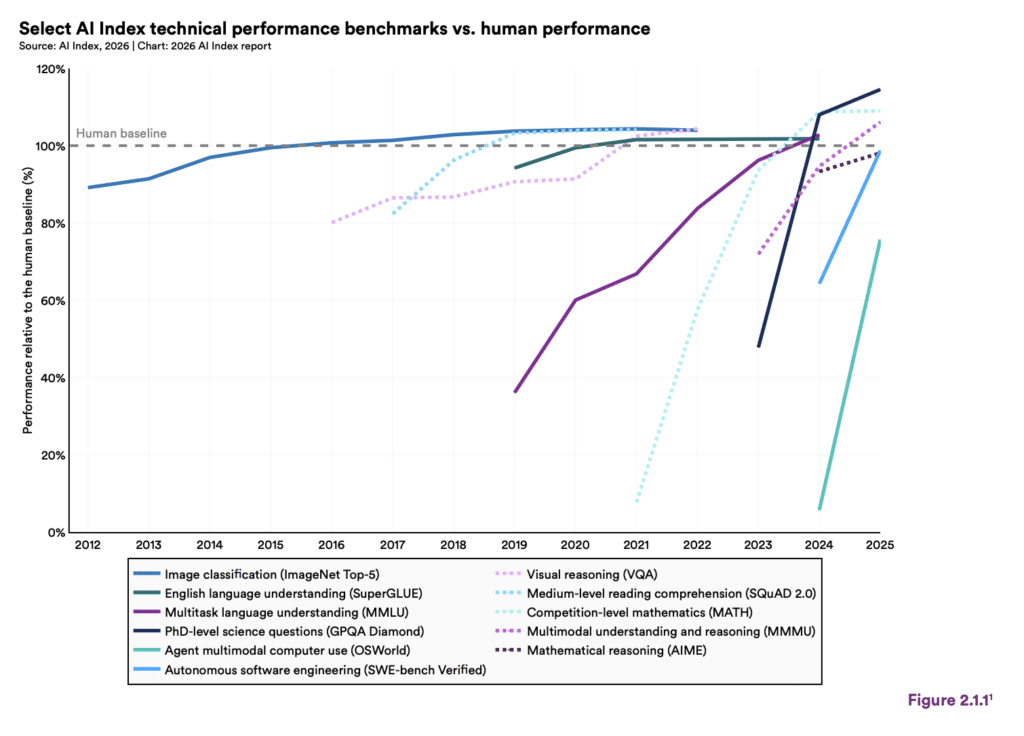
This means that the final steps towards AGI primarily concern two key areas:
- The ability to gather data that AI cannot access through data centres.
- The ability to integrate AI’s data so that it can construct a coherent representation of reality.
These dimensions are not sufficient in themselves, but they create the conditions necessary for developing causal understanding, robustness and goal-directed behaviour.
Gathering data requires the development of senses and robotics
In practice, data gathering means that AI must be equipped with sensory capabilities such as vision, taste, smell and tactile sensing, enabling it to collect its own data about the physical world.
- For this reason, several leading AI developers have significantly increased their focus on robotics during 2026. This applies in particular to NVIDIA, OpenAI (via partnerships), IBM (classical robotics), Anthropic (rapidly building capabilities), SoftBank (through investments), and xAI’s Grok (via partnerships, including with Tesla).
- In addition, newer “AI-native robotics” players have attracted considerable attention, such as Skild AI (backed by SoftBank and NVIDIA) and Mind Robotics (a spin-off from Rivian).
In this context, AI must also learn to sense itself in relation to its environment. These senses are referred to as proprioception and interoception. Technically, this creates a convergence between foundation models, simulations, hardware and data collection.
- More broadly, these capabilities may be necessary to establish a form of internal goal orientation, intentionality. Philosophically, this could be described as a form of synthetic life force, Élan Vital. This “life force” gives AGI identity, goals and purpose, and it is precisely this that creates both significant risks and opportunities.
- According to this perspective, it is here that an AI provider could potentially gain dominance, for example, by aligning AGI’s goals with the provider’s own interests.
- Conversely, it may also be here that AGI emerges as an altruistic force, as suggested by Mo Gawdat, who argues that the highest levels of intelligence often tend towards broader, more inclusive outcomes.
Integrating AI dimensions may be the most difficult challenge, ...
The second key element, integrating AI specialisations, has so far been considered the most difficult.
The human brain is optimised to coordinate sensory inputs. This enables it to continuously simulate (project) future states and determine which threats and opportunities to prioritise.
- In 1943, the Scottish psychologist Kenneth Craik proposed that organisms carry an internal “small-scale model” of the world, which they simulate before acting in reality. Today, this is referred to as RPE (Reward Prediction Error).
- RPE is a central principle of human learning. It means that we constantly generate expectations about how the world will appear in, for example, one second or two minutes. We then primarily notice deviations from those expectations. In this sense, we do not experience the world as it is, but as we expect it to be.
- RPE allows the brain to ignore up to 99.9% of sensory input, thereby avoiding overload. This is a key explanation for why human evolution has outpaced that of other mammals so significantly.
- Technically, the integration of AI specialisations is referred to as multimodality, while forward simulation is often described as in silico.
… because human cognition is shaped by bias
Niels Bohr once noted that physics is not about how the world is, but about what we can say about it. In the context of AGI, this implies that the human brain—whose capabilities AGI seeks to surpass—does not attempt to construct a fully rational or objective representation of reality. Instead, it constructs a representation that ensures survival. This survival-oriented representation is influenced by cognitive biases. For this reason, AGI has long been considered extremely difficult to replicate synthetically.
Google may, however, be approaching a breakthrough ...
In January this year, Google released its experimental AI model, Project Genie. From a prompt or an image, Genie can generate an interactive world that users can explore. Based on an image of a shop shelf, for example, Genie can create a virtual environment populated with relevant products that extend the original concept.
Former Stanford researcher Fei-Fei Li has urther developed these ideas through her start-up, World Labs. Her models enable what is known as Joint-Embedding Predictive Architecture (JEPA), which allows AI to simulate over longer time horizons, rather than just short-term predictions. This form of advanced simulation brings AGI closer overall. However, it does not yet constitute a true breakthrough.
… and progress may accelerate in the coming years
his is an area actively explored by Ilya Sutskever, co-founder of OpenAI, in his Safe Superintelligence project. Sutskever has suggested that existing large language models may already possess rudimentary forms of internal representation that are not yet fully understood. According to his view, these capabilities may be constrained by current control mechanisms within AI systems. He has also speculated that if a system learns the underlying principles of information, it could compress all data on the internet into only a few hundred gigabytes. Offline and computationally efficient AI could enable entirely new applications in robotics, including nanobots, electric vehicles and UAVs.
Taken together, AGI may therefore be only a few years away. It emerges when AI can understand, predict and act in the world as a coherent whole.
But what are the implications of an intelligence that surpasses humans across all domains? How will it challenge the economy, governance, democracy and international cooperation? These questions are explored in the next two blog posts.