

In recent years, a structural rupture has emerged in the cohesion of the West, pointing towards a new geoeconomic world order. This is blog post 3 on the systemic shift, in which the United States is moving from the role of system architect to that of system actor. This transition leads to institutional erosion, shifting the foundations of the global order.
The post-war world order was built on institutions and rules, and thereby on predictability. The United States acted both as a central actor and as guarantor, as this aligned with its own interests. However, Trump’s MAGA approach assesses the net benefits differently. As a result, the model is now unravelling as a consequence of a deliberate strategic realignment.
The result is an emerging multipolar structure without a shared normative architecture.
The contours of a new world order are outlined in six blog posts
This system shift towards a new geo-economic order is outlined across six blog posts:
- The system shift (from rules to power)
- The erosion of institutions (UN, IMF, etc.)
- The US from system architect to system actor - this post
- The two competing system models: China and the EU
- Middle powers and “value-based realism”
- Financial power and the risk of divergence
The first post described the systemic shift, and the second post the institutional consequences. This post focuses on the United States as the driving actor.
The United States seeks to regain a global leadership position
The current US trajectory is not confined to a single administration, but reflects a broader political shift since the 2010s. The prelude was a gradual decline in US industrial competitiveness since the late 1960s, which was reinforced by globalisation. This enabled a focus on service- and knowledge-intensive sectors. The cost was that global specialisation gradually eroded US self-sufficiency and industrial breadth. Since the early 2000s, for example, the trade deficit has increased almost continuously.
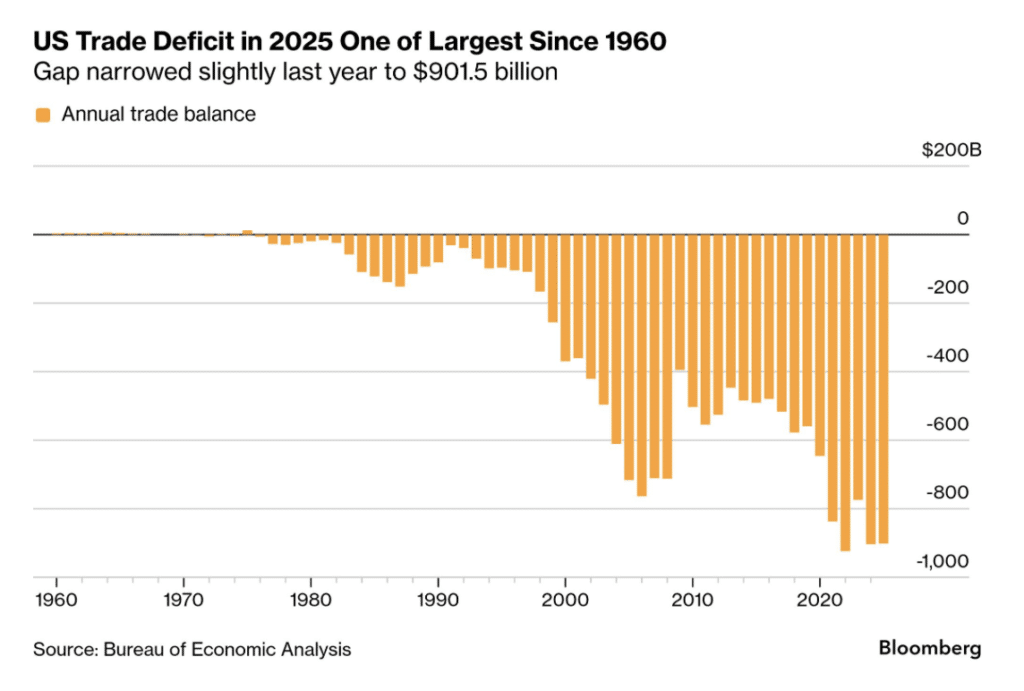
Today, the United States assesses that this order imposed costs that were not offset by corresponding gains. This applies to trade balances, industrial capacity, and security burdens. At the same time, China in particular has caught up with and in some areas surpassed the United States’ technological lead..
Trump therefore views his presidential mandate as a recovery plan, aimed above all at restoring US competitiveness through two major structural initiatives:
- A long-term reindustrialisation to achieve economic and political autonomy
- A broad and deep commitment to AI, intended to drive leaps in innovation and economic growth in both the short and medium term
The plan requires a shift from system architect to system actor …
Transformations of this magnitude cannot be secured through free market mechanisms alone, particularly not in the short term. The United States therefore shifts its role from system architect to a more conventional actor. It cannot simultaneously lead a rules-based order while pursuing protectionist policies. For now, institutional frameworks are applied more selectively.
As a knowledge- and high-technology economy, the United States has become both broadly and deeply dependent on specialised raw materials and intermediate goods. Defence and AI technologies, for example, require rare earth elements, where China holds the largest global capacity for extraction and refining. This capacity cannot be replicated by other countries or alliances within a short time horizon. This exposes the United States to the risk of Chinese retaliation through tariffs and trade restrictions, which could potentially impede US reindustrialisation.
However, the required resources are theoretically present in the subsoil of South and North America, as well as in Greenland. The Trump administration therefore adopts a hemispheric perspective akin to the Monroe Doctrine. Under this view, these regions fall within the US sphere of interest, which in American strategic thinking legitimises increased political and economic influence.
… and is accompanied by a leap in innovation and self-sufficiency
The shift in direction is clearly reflected in US industrial policy.
- With the adoption of the CHIPS and Science Act and the Inflation Reduction Act in 2022, several hundred billion USD in subsidies and tax credits were deployed to strengthen domestic production of advanced semiconductors.
- Subsequently, ambitions have been further expanded through initiatives such as Project Stargate, aimed at AI development and commercialisation.
The objective is both to generate growth through increased productivity and innovation, and to reduce strategic dependencies, particularly on China.
This requires, inter alia, active state protection of US reindustrialisation
Economic instruments are also being applied more directly in foreign policy.
- Since late 2024, the United States has introduced significant export controls targeting China, including on advanced AI chips, AI software, and equipment used to manufacture advanced semiconductors. This includes controls on advanced production machinery (via companies such as ASML), as well as on critical inputs such as refined silicon from the Spruce Pine mine in North Carolina.
- In addition, US public initiatives are investing in the establishment of strategic stockpiles of a wide range of critical minerals and metals, as well as in the Mountain Pass mine in California, which until two decades ago was the world’s largest producer of rare earth elements. The United States has also entered into a broad range of new agreements with, inter alia, Japan and countries in Asia and Africa to secure supplies of industrial metals.
- Financial sanctions continue to be used as a central instrument of US policy. This has included, for example, the freezing of Russia’s foreign exchange reserves following the invasion of Ukraine, as well as an increasing number of financial sanctions packages targeting Russia and Iran.
In practice, economic and security policy are thus becoming intertwined.
Consequently, the nature of US alliances is changing
These developments are also redefining US relations with longstanding allies. In previous National Security Strategies, Europe was regarded as an “unconditional ally”. Today, it is increasingly treated as a “transactional partner”, where underlying values may diverge from those of the United States. The same applies to relations with Canada, where Mark Carney in Davos articulated the new geopolitical reality for middle powers: “If we are not at the table, we are on the menu.”
This shift also affects overseas countries expected to supply industrial metals going forward. Previously, USAID functioned as an instrument of US “soft power” in such regions. In practice, the agency has now been significantly reduced, and recent National Security Strategy documents describe Africa as “peripheral” to Washington’s interests. The strategy has shifted towards “commercial diplomacy”, where any form of assistance is expected to be matched by secure supply arrangements for resources such as industrial metals. In some cases, this is complemented by investment agreements. This has already affected countries such as Angola, the Democratic Republic of Congo, Gabon, Guinea and Nigeria.
Relations therefore persist, but are increasingly characterised by negotiation and concrete interests rather than implicit alignment. This reduces the weight of institutions and weakens incentives for other countries to adhere to shared rules.
Overall, this reinforces the shift towards a multipolar global structure, where relationships are increasingly shaped bilaterally and regionally.
However, this is a high-risk strategy with multiple uncertainties
The United States will remain the world’s dominant economic and military power for many years to come.
However, its role has changed. From underpinning a rules-based order, the United States is moving towards a model in which national interests and strategic flexibility are prioritised over systemic stability.
For companies, this implies that access to the US market will increasingly be linked to political and strategic considerations. At the same time, variability in US policy becomes a structural factor that must be incorporated into long-term decision-making.
The future trajectory will depend on whether this course consolidates, and how other economies choose to respond.
The next blog post will focus on the two competing system models: China and the European Union.