
AI’s combination of pattern recognition and immense computational power offers major potential effect on materials research and quantum chemistry. The opportunities even carry geopolitical significance.
This blog post is the eighth in the series on AI’s disruption of innovation
This blog entry is the eighth in a series about the disruptive impact of a technology based on a new form of intelligence that is self-learning, universally enabling, and allows for deep customization:
- Where does AI impact today?
- What is new and disruptive about AI?
- AI’s effect on robotics and experimental automation
- AI’s effect on climate and meteorological research
- AIs impact on social sciences
- AIs impact on education and mental health
- AI’s impact on biotechnology and pharmaceuticals
- AI’s effect on materials research and quantum chemistry
- AI’s effect on theoretical physics and mathematics
- What should investment strategies in AI take into account?
AI is expected to accelerate materials development significantly
AI accelerates the development of new materials with greater durability, higher tolerances, and lower environmental impact. The current push comes from the need to reduce geopolitical risks in supply chains. As a result, development times are simultaneously shrinking to a fraction of today’s.
Historically, new materials have mostly been discovered through trial and error. For instance, Thomas Edison tested around 6,000 different materials for his lightbulb. Going forward, generative AI makes “inverse design” possible, where the desired properties of a material are specified up front. Likewise, predictive AI can sift through vast databases to identify candidate replacements for existing materials.
There is a need for new materials ...
The commercial perspectives are large and growing due to geopolitical uncertainties, increasing tolerance requirements, and environmental concerns.
Geopolitically, global supply chains are fragmenting. Disruptions in neodymium supply, for instance, are already today a real and critical risk for all companies that use electronics..
Tolerance requirements are also rising. This applies to next-generation chips (beyond silicon or gallium arsenide), batteries (anode, cathode, and electrolyte alike), solar cells, climate-resilient construction materials, and more.
- To circumvent the effects of U.S. sanctions on advanced computer chips, China has been particularly active in developing 2D wafers of indium selenide , which can be layered and folded.AI technologies made this rapid progress possible. Although indium selenide lacks immediate commercial advantages, it has theoretically eliminated China’s vulnerability to chip supply chain disruptions.
- Similarly, ASML and IMEC in Belgium are focusing on photonics-based interposers and CFETs, which will eventually phase out silicon, and with it dependency on the U.S. (Spruce Pine Mine), though only in the longer term.
It has also become increasingly necessary to develop recyclable or biodegradable materials to reduce environmental and climate impacts. Most extraction and refining processes for raw materials remain highly polluting to local environments, often with radioactive contamination.
- AI models have, for example, proven useful in integrating vast amounts of geological data for companies like BHP and Rio Tinto.
- They have also significantly increased the efficiency and potential of geothermal systems.
- Finally, research in Finland and Canada has applied AI to develop bacterial consortiacapable of isolating copper and rare earth elements.
… which AI is precisely needed to develop
Inverse design and predictive screening have become possible thanks to AI’s massive computational power, morphogenetic capabilities, and self-learning. This allows for a faster path from ideas to candidate materials. In 2023, for instance, Google DeepMind’s GNoME identified over 2.2 million new crystal structures, 380,000 of which are considered stable enough for practical use. IBM and MIT have likewise been highly active in this field. The same methods have been applied to machine intelligence, guided design of polymer membranes and, for example, high-temperature alloys.
AI can simulate material tolerances and behavior under extreme conditions, drastically reducing development timelines. In the 1980s, lithium-ion technology took 10–15 years to mature. By contrast, at the end of 2023, Berkeley Lab simulated over 100,000 potential electrolytes. The TRL 1–4 stage took only a few weeks, from which a few hundred candidate materials were selected for TRL 5–8 development. Similarly, in early 2024, Microsoft and PNNL developed a solid-state battery up to TRL 5. The entire process took just 80 hours, completed over a single weekend.
Nanomaterials are another key focus area. In spring, for example, Caltech and the University of Toronto developed a simulated lattice material five times stronger than titanium but lighter in weight. NVidia is also heavily active here, as nanophotonics are central to next-generation chips.
This is also relevant for Energy Production and Climate Transition ...
New materials are also being designed for carbon capture. AI has identified synthetic rock-dust compounds that can be spread on farmland to sequester CO₂ while enriching soil with essential minerals.
Similarly, the efficiency of solar cells is expected to multiply thanks to new “black” metal composites, which AI has shown to be practically viable.
... and for Quantum Chemistry and Quantum Computers
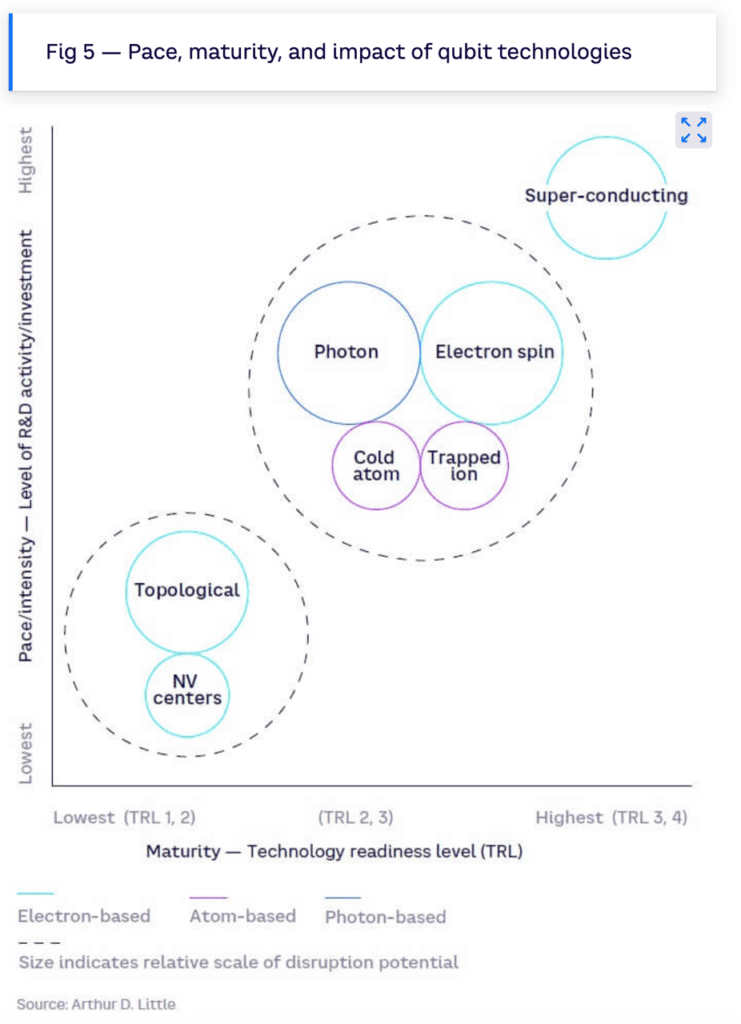
Quantum chemical calculations are highly precise and therefore extremely time- and resource-intensive on traditional supercomputers. Quantum computers are closely tied to materials research, where progress depends on advances in superconductors and nanotechnology (see below). Microsoft, Amazon, and Google have each launched new qubit technologies (Majorana, Ozelot, Willow), with their own distinctive features, strengths, and weaknesses.
But software development is especially lagging behind. AI’s unique capabilities are critical for developing software to run simulations of quantum-physical systems. These were previously computationally unrealistic but are essential to accelerating the development of quantum chips and their software layers. Today, 3 out of 4 experts estimate that quantum computers will reach commercial scale (TRL 8–9) by 2032 at the latest.
The field is therefore of both strategic and geopolitical significance ...
The geopolitical uncertainties of recent years have highlighted the world’s supply dependencies. In many cases, these risks are critical. As a result, ambitions have risen to replace natural materials that are only available, mined, or refined in a handful of countries. This affects, for instance, the design of new materials for superconductors, lightweight composites, battery materials, and magnetic applications.
- Over the past 4–6 years, the U.S. Department of Defense has conducted intensive research into alternative compounds to rare earths. This includes substitutes for super-magnetic neodymium, a cornerstone in all electrical products (see above). This dependency is one reason why one of the first investments of the U.S.’s new Sovereign Wealth Fund was in MP Materials. The company owns a California mine that was the world’s largest rare earth producer until the 1990s, when China took over the role.
- Meanwhile, companies like Hitachi Metals, Niron Magnetics, Denso, Toshiba, and several Indian firms are developing alternatives to rare earths—especially neodymium. The EU is also active with PASSENGER projects under the EU Critical Raw Materials Act..
- Tesla and CATL, for their part, use AI technologies to identify substitutes for cobalt and nickel, most of which are currently extracted in the DR Congo, Russia, and Indonesia.
- AI models also help optimize the design of thin-film materials (such as perovskites, i.e. organic solar cells), which can be manufactured without rare earths and produced on nearly every continent.
- AI models likewise support the design of next-generation chips, free of silicon (dominated by the U.S.) or gallium/arsenide (dominated by China).
... and thus many are very active, including Big Tech
Big Tech is highly engaged in this field. Google’s DeepMind has developed GNoME and AlphaFold. Microsoft is focused on quantum chemistry (Azure Quantum) and collaborates with PNNL. IBM works on designing crystals, polymers, and catalysts, as well as new materials for quantum computers. NVidia is concentrating on hardware and software platforms, with partnerships particularly in Big Pharma.
Among industrial companies, BASF, Dow, DuPont, and 3M are generally far ahead. Among academic institutions, Lawrence Berkeley National Lab is especially active in developing new materials. In nanomaterials, quantum chemistry, and fusion energy, leading players include MIT, Caltech, the University of Toronto, and Carnegie Mellon University. In Europe, the University of Oulu in Finland, Pforzheim University, and Cambridge are particularly noteworthy.